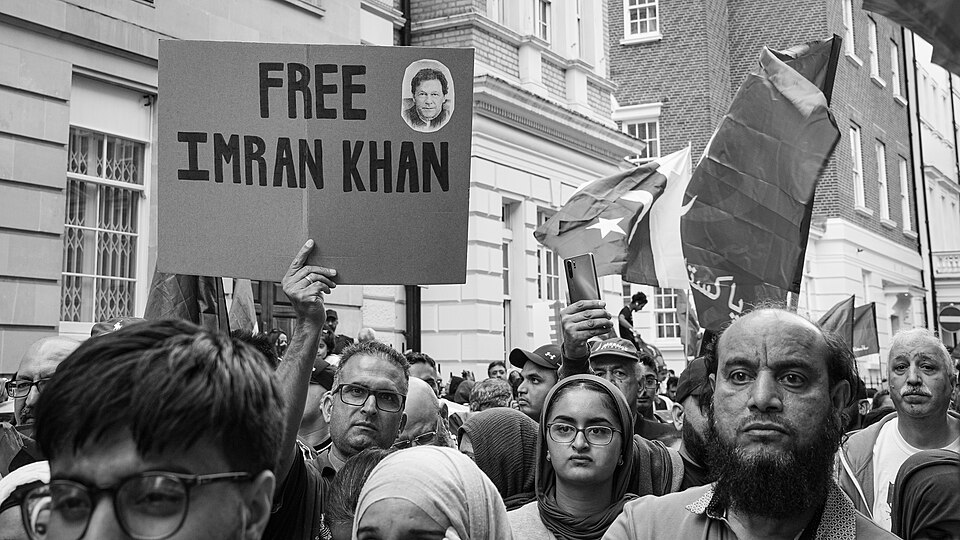
Imran Khan's sons painted a picture of a man broken by prison during a Sky Sports interview at Lord's, even as his cricketing legend looms larger than ever in Pakistan's collective memory.
At cricket's sacred headquarters, the interview broadcast during the lunch break of the England-Pakistan Test became a moment where sport, politics, and personal tragedy collided. Sulaiman and Kasim Khan alleged their father had lost 80 percent of sight in one eye, wore an eye patch, and was kept in solitary confinement for over 23 hours daily. The PCB's immediate objection and subsequent formal complaint to the broadcaster revealed an administration caught between institutional loyalties and the undeniable human gravity of the situation.
The Pakistan Cricket Board considered recalling players for the afternoon session, a move that would have abandoned the Test at Lord's. That they ultimately returned to the field does not absolve the governing body of appearing to prioritize diplomatic optics over humanitarian concern. Cricket has always carried political weight in Pakistan, but rarely has the weight of one man's captivity so visibly pressed against the boundaries of a Test match.
The Captain Who Refused to Let Go
There is a danger in allowing the mythology of Imran Khan the captain to overshadow the cricketer who preceded him. Imran Khan did not arrive as the finished fast-bowling all-rounder of the 1980s and early 1990s. He began as a relatively raw bowler, gradually refining himself into a genuinely quick and accomplished exponent of swing bowling.
His batting underwent a parallel transformation. What began as useful lower-order contributions evolved into a formidable all-round skill that could alter the course of a Test match in either discipline. Sanjay Manjrekar recalled a telling moment from India's 1989 tour of Pakistan that captured this evolution. By then, Imran had lost much of the pace that once made him a feared bowler, yet the Indian players never sensed opportunity with either ball or field. Manjrekar remembered long, punishing days in the field where India piled on runs, but Imran's concentration never wavered. His eyes were always focused, locked on the next ball, the next chance to strike.
That focus defined his cricketing leadership. As captain, Imran Khan turned Pakistan cricket from talented underachievers into a team capable of winning the 1992 Cricket World Cup against all odds. The imagery was perfect: a man who had mastered his own raw materials into something refined, leading a nation's cricket to its greatest triumph. It was leadership that transcended tactics, becoming almost spiritual in its conviction.
When the State and the Saint Collide
The PCB's complaint to Sky Sports exposed the tangled relationship between cricket administration and political authority in Pakistan. The board's discomfort stemmed not merely from airing private family grievances, but from the uncomfortable contrast the interview created between Imran Khan's current physical vulnerability and the imposing public image that has defined Pakistan cricket for decades.
For nearly three years, Imran Khan has remained imprisoned, a fall from grace that mirrors Pakistan's own struggle with democratic institutions. His detention has sparked international concern, with human rights organizations and foreign governments questioning the circumstances of his confinement. Yet within the narrow confines of the pitch at Lord's, the cricket community watched a former hero's sons plead for access to books and basic comforts — allegations the Pakistani authorities have consistently rejected, citing that Khan has received medical attention and visitor access.
This tension reveals how cricket in Pakistan operates as more than sport. It functions as a vessel for national identity, where the line between sporting hero and political figure dissolves. When Imran Khan's sons alleged their father was being deliberately harmed — that the authorities were "blatantly trying to kill him" — the statement carried the weight of someone who understands that cricket in Pakistan is never just about cricket.
What the Eyes Still See
Imran Khan's transformation from raw bowler to swing maestro offers a metaphor for his broader journey. He learned to work with less pace by maximizing guile, to rely on deception when power waned, and to find concentration even when the body betrayed earlier capabilities. That same man, according to his sons, now wears an eye patch and struggles with basic comforts in a Pakistani prison.
The irony is not lost on those who followed his career: a man whose cricket was defined by his ability to adapt and overcome adversity now faces his greatest challenge not on a cricket field, but in a system where legal and political forces have overtaken athletic achievement. His eyes, once described by Manjrekar as laser-focused on the next ball, now reportedly struggle with vision that cricket once demanded in sharp relief.
The England-Pakistan Test continued after the interview aired. The players returned to the field, the PCB lodged its complaint, and Lord's moved on. Yet the image of Imran Khan's sons speaking at cricket's moral center, their allegations hanging in the air between the pavilion and the nursery end, will persist longer than any match result. Cricket refused to let go of Imran Khan when he played — and now, it seems, cricket cannot let him go even in captivity.
The IPL Stats Hub reminds us that numbers outlast narratives, but few statistics carry the weight of legacy interrupted. Imran Khan's cricketing records — 84 Test wickets in 1982-1992, a captaincy win rate that elevated Pakistan to the summit of world cricket, a World Cup victory that defied logic — remain intact on paper. They cannot capture the image of a man whose sons felt compelled to speak at Lord's, or the PCB's desperate attempt to shield their former hero from the world's gaze.
The captain cricket won't let go, but now it is the captain who is being held, and the sport that watches helplessly from the boundary ropes.